Men vs. Women: Is Your Metabolism Really That Different?

You have probably heard this before:
“Men have faster metabolisms.”
“Women have a harder time losing weight.”
“Men and women need completely different workouts.”
There are definitely differences between men and women. Hormones, muscle mass, body fat distribution, and other biological factors all play a role.
But when it comes to metabolism, fat loss, and performance, the difference is often not as simple as “men vs. women.”
A lot of what we see comes down to body size, muscle mass, body composition, fitness level, and lifestyle.
And that is important because your training and nutrition plan should be based on you, not just whether you are male or female.
Why Men Often Burn More Calories

On average, men tend to burn more calories than women.
But a big reason for that is pretty straightforward: men are usually larger and tend to carry more muscle mass.
A 210-pound man with a lot of lean mass is going to have different calorie needs than a 140-pound woman.
That does not automatically mean his metabolism is “better.”
He simply has a larger body that requires more energy.
Muscle mass also matters. The more lean tissue you carry, the more energy your body needs to maintain it.
So instead of thinking:
“Men have fast metabolisms and women have slow metabolisms,”
a better way to think about it is:
Larger bodies with more lean mass usually require more energy.
That is true whether you are a man or a woman.
Women Do Not Need Completely Different Workouts

This is one area where the fitness industry has made things more confusing than they need to be.
Men are often encouraged to lift heavy weights, get stronger, and build muscle.
Women are often encouraged to use light weights, do high repetitions, and “tone.”
But your muscles respond to training in many of the same basic ways.
If you want to get stronger, you need to gradually challenge your muscles.
If you want to maintain muscle while losing body fat, strength training should be part of the plan.
If you want to stay strong and capable as you get older, strength training becomes even more important.
That applies to both men and women.
The exercises, weights, volume, and overall plan may be different from person to person, but that should be based on the individual.
Not simply gender.
That Doesn't Mean Men and Women Are Exactly the Same

There are still differences that matter.
Men tend to carry more muscle mass, especially in the upper body.
Women generally carry a higher percentage of body fat and may store it differently.
Hormones can also affect recovery, performance, appetite, and body composition.
For women, things like the menstrual cycle, pregnancy, perimenopause, and menopause can also affect how they feel and respond to training.
Those things should not be ignored.
But they are just one part of the overall picture.
Your age, training history, stress level, sleep, nutrition, activity level, injuries, and goals can matter just as much — and sometimes more — when building a program.
What I See More Often With Adults Over 35
For most busy adults I work with, gender is usually not the main thing holding them back.
It is more often something like this:
Work has gotten busier.
You are sitting more.
You are sleeping less.
Your stress is higher.
Meals are inconsistent.
You are not strength training regularly.
You are moving less during the day.
And every time you decide to get back in shape, you try to change everything at once.
You train hard for a few weeks.
You cut your calories way down.
You avoid foods you enjoy.
Then life gets busy again and the whole thing falls apart.
A few months later, you start over.
After doing that enough times, it is easy to say:
“My metabolism just isn’t what it used to be.”
Sometimes metabolism is part of the conversation.
But very often, the bigger issue is that your routine no longer matches your goals.
Your Metabolism Is More Than Just How Many Calories You Burn

When people hear the word metabolism, they usually think about whether they have a fast or slow metabolism.
But metabolic health is bigger than that.
It is also connected to how well your body handles energy, blood sugar, activity, food, sleep, stress, and recovery.
That is one reason I put so much emphasis on strength training.
Muscle is valuable.
It helps you stay strong.
It supports healthy aging.
It helps you maintain your physical abilities.
And it gives you more flexibility when it comes to body composition and weight management.
You do not need to become a bodybuilder.
You just want to keep the muscle you have and build more when it makes sense.
The Better Question to Ask

Instead of asking:
“Do I need a men’s plan or a women’s plan?”
Ask:
“What does my body and lifestyle need right now?”
How often can you realistically train?
How active are you during the day?
Are you eating enough protein?
Are you sleeping well?
How stressed are you?
How much strength have you lost over the last few years?
What kind of plan can you follow when work gets busy?
Those are the questions that usually lead to better results.
What Works for Most Busy Adults

The basics are actually pretty simple.
You need consistent strength training.
You need enough protein and a nutrition plan that fits your goals.
You need daily movement.
You need some form of cardiovascular exercise.
You need sleep and recovery.
And you need to stay consistent long enough for those things to work.
The hard part is not knowing that those things matter.
The hard part is making them fit into your life.
That is where having a clear plan becomes valuable.
You Probably Don't Need Another Extreme Plan

If you have been starting and stopping diets or workout programs, I would not recommend jumping into another aggressive 30-, 60-, or 90-day challenge right away.
Start by getting the basics under control.
Train.
Move.
Eat better.
Recover.
Pay attention to how your body responds.
That is the idea behind my 7-Day Metabolic Test Drive.
It is a simple way to experience a more structured approach to fitness without trying to change your entire life overnight.
The goal is not to completely transform your body in seven days.
The goal is to help you start building a routine that actually works for you.
Because most people do not need more random workouts or another restrictive diet.
They need a plan they can follow consistently.
Ready to Stop Starting Over?
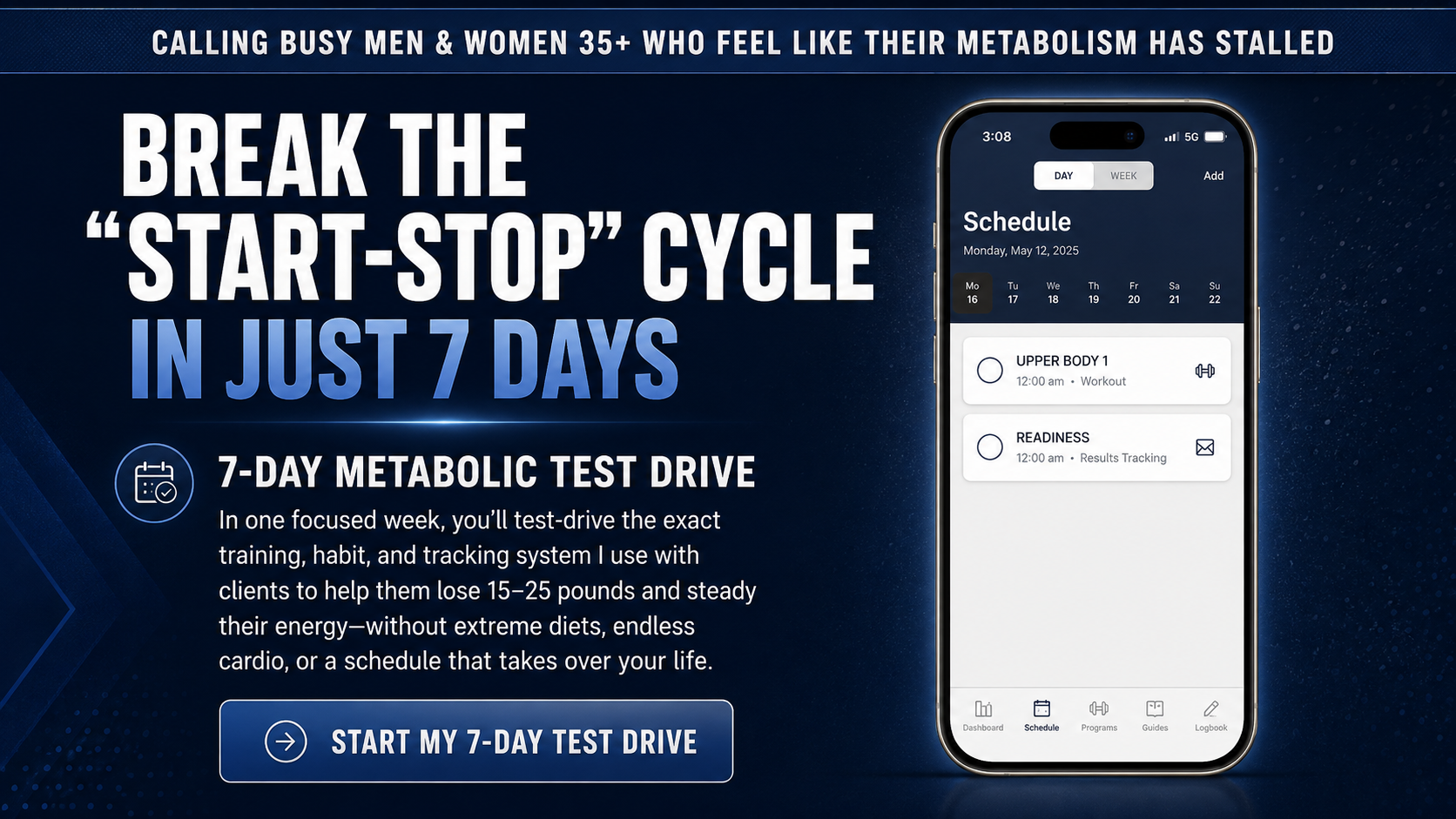
If you are 35+ and want to lose body fat, get stronger, improve your energy, and feel better without living in the gym or following an extreme diet, the 7-Day Metabolic Test Drive is a good place to start.
For seven days, you can experience the Refined Strength System approach to training, nutrition, and accountability.
No extreme overhaul.
No guessing.
Just a simple plan designed to help you start moving in the right direction.
Sources & Further Reading
Arciero, Goran & Poehlman — “Resting metabolic rate is lower in women than in men.” This study looked at resting metabolism across men and women while accounting for body composition and aerobic fitness. It found that fat-free mass, fat mass, fitness, and sex together explained much of the variation in resting metabolic rate.
Read the study on PubMedNuzzo — “Sex Differences in Muscle Strength, Endurance, Size and Adaptations.” A detailed review of differences between men and women in muscle mass, strength, endurance, and responses to strength training. Importantly, both men and women can make substantial improvements in muscle size and strength through resistance training.
Read the review on PubMedAmerican College of Sports Medicine — Resistance Training Position Stand. ACSM's updated 2026 review analyzed evidence from more than 30,000 participants and found that progressive resistance training improves strength, muscle size, power, endurance, and physical function in adults.
Read the ACSM position stand on PubMedHunter et al. — “The Biological Basis of Sex Differences in Athletic Performance.” This ACSM consensus statement explains how hormones, muscle mass, body composition, hemoglobin, cardiovascular physiology, and other factors contribute to average performance differences between males and females.
Read the consensus statement on PubMed“Sex Differences in Energy Metabolism: A Female-Oriented Discussion.” This review looks specifically at metabolism at rest and during exercise and explains how factors such as age, diet, hormones, pregnancy, perimenopause, and menopause can affect metabolic differences.
Read the review on PubMedExercise and Body Composition in Postmenopausal Women. This systematic review and meta-analysis included 101 studies and more than 5,600 women. Exercise improved several body-composition measures, with resistance training particularly useful for supporting muscle mass.
Read the review on PubMed
