How to Start Improving Your Metabolic Health in 5 Steps—Even With a Busy Schedule

Without knowing how to build a realistic routine that supports your metabolic health, it can be difficult to improve your strength, body composition, energy, and overall confidence.
Instead, you may continue jumping between inconsistent workouts, restrictive diets, and complicated health advice that never seems to fit your actual schedule.
You’re in the right place.
I created this practical five-step process to help busy professionals begin improving the lifestyle factors connected to metabolic health. It is based on more than 20 years of experience helping people become stronger, improve their nutrition, and build routines they can maintain outside of a perfect week.
We’ll cover everything from assessing your starting point and scheduling strength workouts to improving your nutrition, increasing daily movement, and adjusting your routine based on what your body and schedule are telling you.
I’ll also explain what to look out for along the way, including mistakes I frequently see busy professionals make when they try to change too much, too quickly.
By the time you finish Step 5, you’ll have a clear starting plan that can help you become more consistent, gather useful information about your habits, and begin making progress without turning fitness into a second full-time job.
Ready? Let’s go.
Educational disclaimer: This article is intended for general educational purposes and is not a substitute for medical advice, diagnosis, or treatment. Metabolic syndrome is diagnosed by a qualified healthcare professional using medical history, a physical examination, blood-pressure readings, waist measurements, and laboratory testing. Speak with a healthcare professional about diagnosis, medications, symptoms, existing medical conditions, or changes to your medical treatment.
Step #1: Establish Your Starting Point
Before you can decide how often to train, what nutrition habits to change, or how much activity to add, you need to understand your current starting point.
You do not need to track every calorie, weigh yourself several times per day, or purchase an expensive fitness device.
You simply need enough information to identify your most important patterns.
Start by looking at two areas: your medical information and your current lifestyle.
Review your medical starting point

Metabolic syndrome is not one isolated condition. It refers to a group of risk factors that, when present together, can increase the risk of serious health problems.
Healthcare professionals may consider factors such as blood pressure, blood glucose, triglycerides, HDL cholesterol, and waist circumference when evaluating someone for metabolic syndrome. Family history, genetics, other health conditions, medications, physical activity, sleep, and eating habits can also affect risk.
Ask yourself:
When was my most recent physical examination?
Have I had my blood pressure checked recently?
Have I had recent bloodwork?
Has a healthcare professional discussed my blood sugar, cholesterol, triglycerides, or waist measurement with me?
Am I taking medications that may affect my exercise, appetite, heart rate, blood pressure, or blood sugar?
Do I have an injury or medical condition that may require exercise modifications?
You are not trying to interpret all of this information by yourself. You are identifying what you know, what you do not know, and what may require a conversation with your healthcare provider.
Review your lifestyle starting point
Next, look at what is happening during a typical week.
For seven days, make a simple note of:
How many hours you sleep
How energetic you feel
How many workouts you complete
How much time you spend sitting
Whether you take walking or movement breaks
How regularly you eat balanced meals
When your hunger is highest
What creates the most stress
What usually causes your routine to break down
You are not trying to earn a perfect score. You are looking for patterns.
For example, you may think your biggest problem is a lack of motivation. After tracking your week, however, you may discover that you are scheduling workouts after long workdays when you rarely have the energy to complete them.
That is not a character flaw. It is a scheduling problem.
You may discover that you regularly skip lunch, become extremely hungry in the evening, and then feel as though you have no control around food.
That does not necessarily mean you need a stricter diet. You may need a more dependable lunch.
Choose two or three priorities
After reviewing your week, choose the two or three areas that would make the biggest immediate difference.
Your priorities might be:
Completing two strength workouts
Eating a balanced lunch during the workweek
Taking a short walk after dinner
Establishing a more consistent bedtime
Scheduling a physical examination
Preparing a backup meal for late work nights
Do not try to correct everything at once.
Your initial goal is to create a clear starting point and identify the first actions you can realistically repeat.
For example: Create a seven-day health snapshot
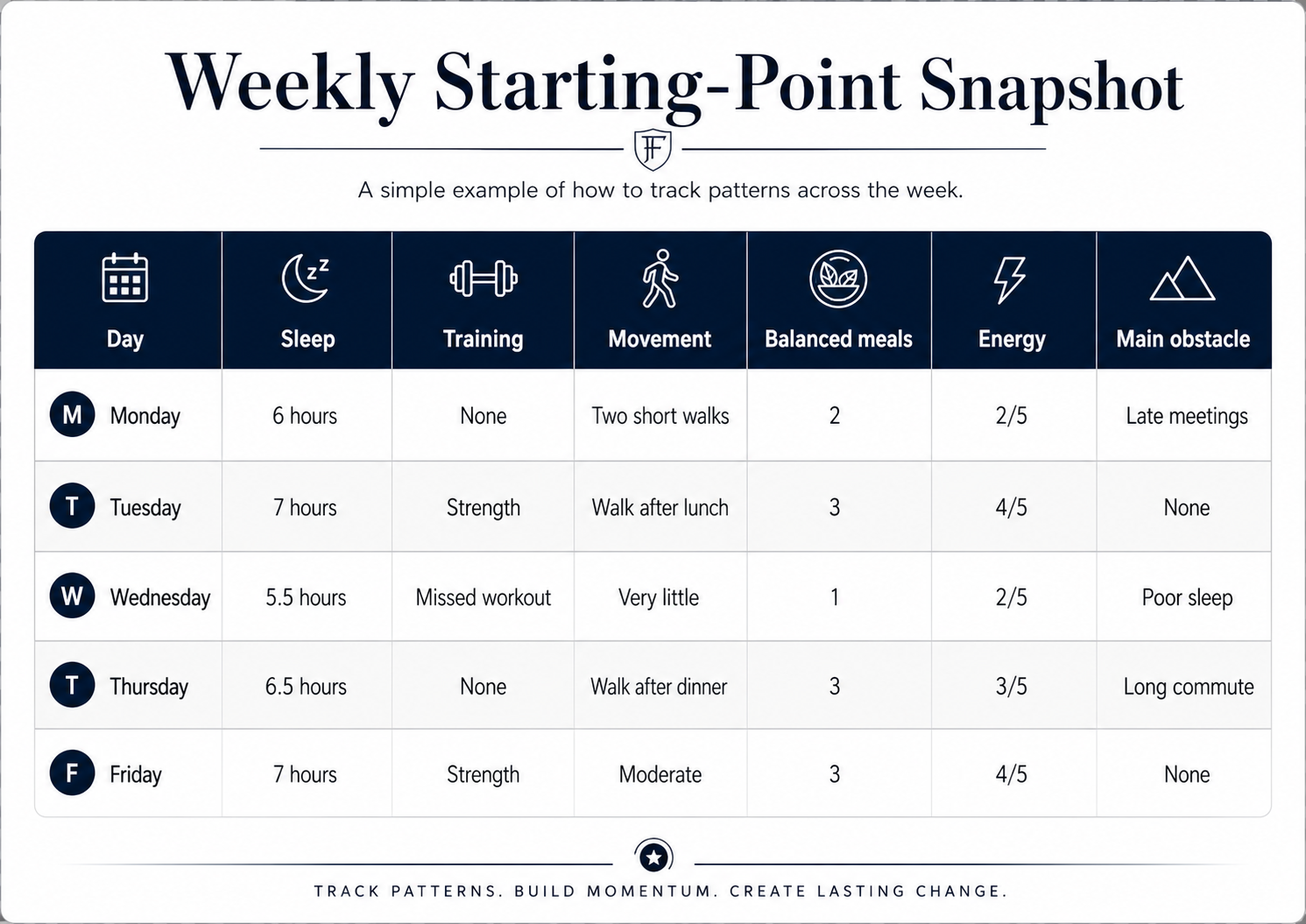
This information can immediately show you what is helping and what is getting in your way.
In this example, the person completed both workouts on days when they slept more and had fewer scheduling conflicts. Their next step might be protecting those workout times instead of adding more sessions.
Suggested visual: Insert a branded “Seven-Day Metabolic-Health Snapshot” graphic with spaces for sleep, training, meals, movement, energy, stress, and schedule obstacles.
What to look out for
Many people skip this foundational step and then wonder why they cannot stay consistent.
Don’t let that be you.
Avoid turning your starting assessment into a judgment about whether you have been “good” or “bad.” The information is there to help you make decisions—not to make you feel guilty.
Also avoid using one weigh-in, one blood-pressure reading, a fitness tracker, or an online questionnaire to diagnose yourself.
Some metabolic-syndrome risk factors may not cause obvious symptoms, which is another reason routine healthcare and appropriate testing matter.
Look for repeated patterns rather than isolated days.
Instead of saying, “I have no discipline,” try saying, “I miss workouts when I schedule them after late meetings.”
The second statement gives you something useful to change.
This is a crucial foundational step that will set you up for success later. Each step builds on the one before it, so resist the urge to jump ahead and copy someone else’s routine.
All done?
Great job. Let’s move on to Step 2.
Step #2: Schedule Two Full-Body Strength Workouts
At this point, you may be thinking that adding strength training to your schedule will be the most difficult part of this process.
You may even be wondering, “How am I supposed to work out consistently when I barely have time to finish everything else?”
Stay with me. This does not require six workouts per week or two-hour gym sessions.
What we are doing is creating a basic training structure that can survive your normal responsibilities.
One thing that may help is to schedule your workouts before the week begins. Treat them like important appointments instead of activities you will fit in only when everything else is finished.
For many busy professionals, two full-body strength sessions are a practical place to begin.
Current federal physical-activity guidance recommends muscle-strengthening activity on at least two days per week. Adults who are currently inactive are encouraged to start with smaller amounts of activity and gradually build toward the broader recommendations.
Choose two realistic training days

Look at your actual calendar and select two days that have the highest probability of working.
A realistic schedule might be:
Tuesday morning and Saturday morning
Wednesday evening and Sunday afternoon
Monday at lunch and Thursday after work
Two appointments with a personal trainer
One weekday workout and one weekend workout
Do not automatically choose the schedule that looks best on paper.
Choose the schedule that is most likely to survive meetings, family responsibilities, commuting, travel, and normal fatigue.
Train the major movement patterns
A full-body workout does not need dozens of exercises.
A simple routine can include:
A squat or knee-dominant movement
A hip hinge or hip-dominant movement
An upper-body pushing movement
An upper-body pulling movement
A core, stability, or loaded-carry exercise
The exact exercises should reflect your experience, mobility, equipment, injuries, and medical considerations.
For one person, a squat movement may be a barbell back squat. For another, it may be a supported box squat or a leg-press variation.
The movement category can stay the same even when the exercise changes.
Keep the session manageable
A beginning session might last 30–45 minutes and include:
A brief warm-up
Four or five primary exercises
Two or three working sets of each movement
Appropriate rest between sets
A short cooldown when helpful
The goal is not to exhaust yourself.
The goal is to practice the movements, establish consistency, and gradually become stronger.
Suggested visual: Insert a two-column “Workout A and Workout B” graphic.
A simple two-day strength framework
Workout A
Squat variation
Horizontal pushing exercise
Horizontal pulling exercise
Hip-dominant assistance exercise
Core or carry
Workout B
Hip-hinge variation
Vertical or angled pushing exercise
Vertical pulling exercise
Single-leg exercise
Core or carry
This framework helps you train your full body while keeping the routine simple enough to repeat. This step is important because it gives your week structure and makes it easier to progress intentionally. You will also have a repeatable training method that allows you to monitor your exercises, repetitions, weights, technique, and recovery instead of performing random workouts.
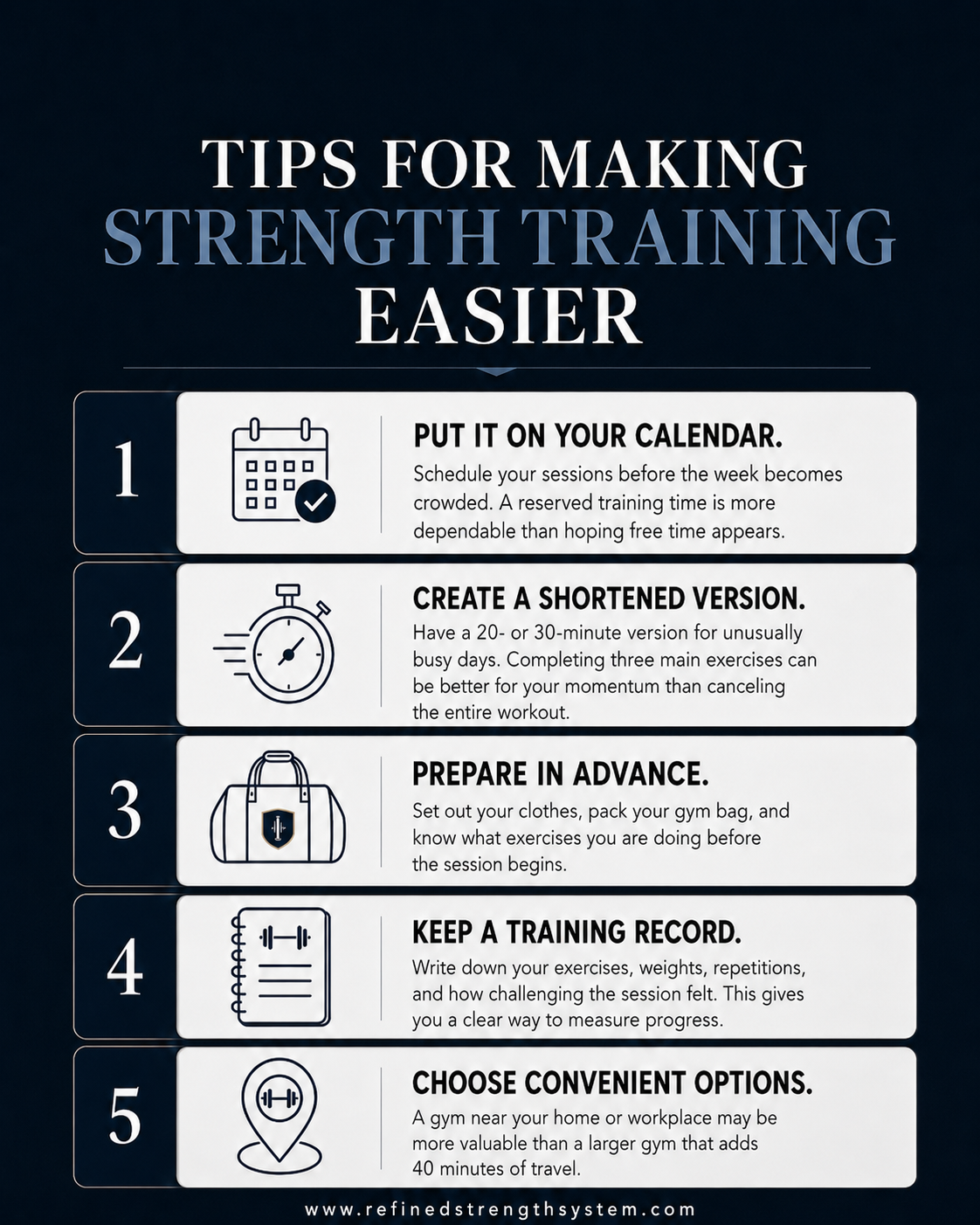
Tips for making strength training easier
What to look out for
One of the most common mistakes people make when returning to exercise is trying to do too much too soon. They go from no consistent training to five or six intense workouts per week. They become extremely sore, miss several sessions, and assume they lack motivation. Instead of beginning with the maximum amount of exercise you can survive for one week, begin with an amount you can repeat. Here are several mistakes to avoid:
Starting too aggressively.
Instead of taking every exercise to failure, finish your early sessions feeling as though you could have completed a little more.
Copying an advanced program.
You will get better results from a routine that matches your current ability than from copying someone who has trained consistently for 10 years.
Changing exercises every week.
If you constantly replace your movements, it becomes difficult to improve your technique or measure progress.
Treating soreness as the goal.
A workout does not need to make walking down the stairs painful to be useful.
Training through pain.
Muscular effort and mild discomfort are not the same as sharp, worsening, or unusual pain. Modify or stop an exercise when appropriate and seek professional guidance for injuries or concerning symptoms.
Canceling because you are short on time.
When a full session is impossible, complete your shortened version.
Keep paying attention to your technique, effort, and recovery, and you will be on the right track.
Step #3: Build Three Repeatable Nutrition Anchors
Are you starting to feel like this is becoming more manageable? I hope so. We are putting the major pieces into place. You may still feel overwhelmed by nutrition, and that is completely normal. There is no shortage of conflicting information about calories, carbohydrates, fasting, meal timing, supplements, and the “best” diet. You do not need to solve every nutrition question today. Instead, begin by creating three repeatable nutrition anchors. A nutrition anchor is a meal or behavior you can rely on during a normal workweek. It reduces the number of decisions you need to make and gives your day more structure.
Choose a dependable first meal

Your first meal should be something you enjoy, can access easily, and can repeat. Depending on your preferences and schedule, that might include:
Eggs, whole-grain toast, and fruit
Greek yogurt, berries, oats, and nuts
A protein smoothie with fruit
Oatmeal with a protein source
A prepared breakfast sandwich with fruit
The goal is not to force yourself to eat breakfast at a certain time. The goal is to know what your first meal will be instead of waiting until you are extremely hungry.
Create a balanced workday lunch
Lunch is often where a busy professional’s nutrition begins to break down. Meetings run late. Work piles up. Lunch gets delayed or skipped. By the end of the day, hunger is extremely high. Choose one or two lunches you can repeat.
A practical balanced meal can include:
A protein source
Vegetables, fruit, or another fiber-rich food
A carbohydrate source that fits your needs
A source of dietary fat
Examples include:
A chicken, tofu, or salmon grain bowl
A turkey or tempeh wrap with a side salad
A burrito bowl with protein, beans, vegetables, and rice
A large salad with protein, potatoes or grains, and dressing
Dinner leftovers packed in advance
Healthy eating patterns can include a variety of vegetables, fruits, protein foods, healthy fats, and whole grains. The exact amounts and food choices should reflect the individual’s needs, preferences, culture, budget, medical conditions, and goals.
Plan an evening meal and a backup option
Your evening meal does not need to be elaborate.
Choose a few combinations that are easy to prepare:
Salmon, potatoes, and vegetables
Chicken, rice, and a frozen vegetable blend
Lean beef or tofu stir-fry
Turkey chili with beans
Pasta with lean protein and vegetables
Rotisserie chicken, microwaveable rice, and salad
Then create an emergency backup for late nights.
Your backup might be:
A prepared grocery-store meal
Frozen vegetables with a precooked protein
A healthy frozen entrée with additional vegetables
A restaurant order you have already selected
A sandwich, fruit, and yogurt
A simple protein smoothie and another satisfying food
Your backup option prevents a stressful day from turning into a night of extreme hunger and impulsive decisions.
Example: A meeting-heavy workday
Imagine you have meetings from 9:00 a.m. until 4:00 p.m.
Instead of relying on willpower, your day could look like this:
Morning: Eggs, toast, and fruit before the first meeting.
Lunch: A prepared chicken-and-rice bowl eaten during a protected 20-minute break.
Afternoon: Greek yogurt and fruit because dinner will be late.
Dinner: A simple stir-fry with protein, vegetables, and rice.
Emergency alternative: Rotisserie chicken, frozen vegetables, and a microwaveable grain.
This is not a perfect meal plan. It is a realistic plan that reduces decision fatigue.
While you are building these anchors, make a note of your hunger, energy, digestion, training performance, and how easy the meals are to repeat. This information matters because a plan that looks healthy but leaves you constantly hungry, drained, or unable to follow it may need to be adjusted.
Make those adjustments before you add more rules.
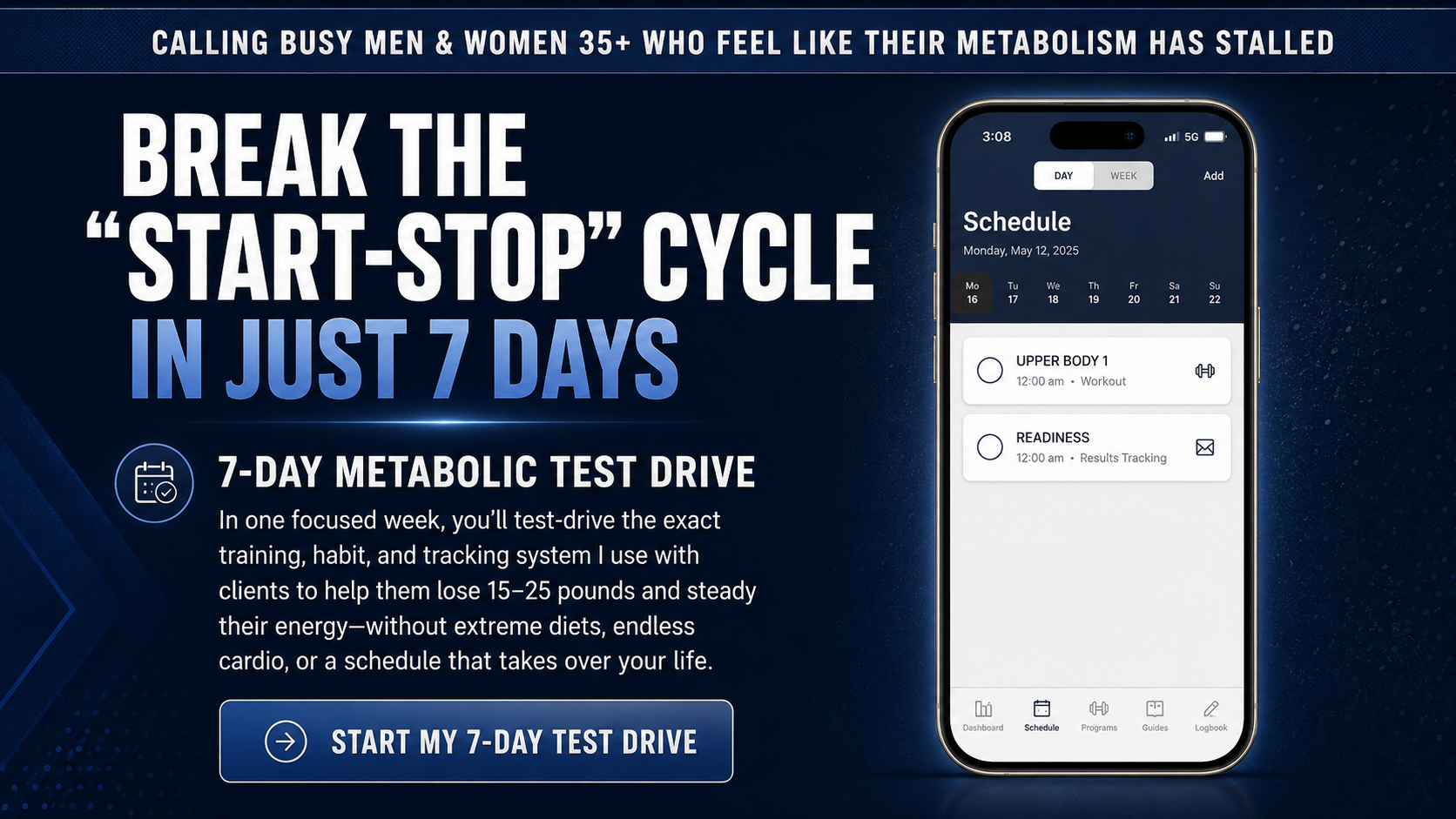
Put the process into practice with the 7-Day Metabolic Test Drive
Understanding the habits is one thing. Organizing them into a real week is another.
The 7-Day Metabolic Test Drive is a focused one-week experience that allows you to practice a structured training, habit, and tracking system without committing to an extreme diet or complicated program.
It includes:
Training and habit tracking
Start and end weigh-ins
Start and end tape measurements
Daily encouragement
Access to a private Facebook group
Support, questions, and accountability
The purpose is not to promise that you will lose a specific amount of weight or dramatically change your health in seven days. It is an opportunity to follow a plan, gather personal information, identify patterns, and begin building momentum.
Suggested visual: Insert a branded mockup of the Test Drive tracker displayed on a phone, along with a checklist of what is included
What to look out for
It can be difficult to decide how structured your nutrition needs to be. Some people respond by creating too many rules. They remove multiple foods, try to eat perfectly, and believe one unplanned meal has ruined the entire week. Instead, use enough structure to make your choices easier without making your life smaller.
Try the following:
Repeat a few dependable meals.
Keep convenient backup foods available.
Plan for business dinners and social events.
Eat normally before and after special occasions.
Return to your regular routine after an unplanned meal.
Review your consistency over several weeks rather than judging one day.
Do not compensate for eating by skipping meals or using punishment-based exercise.
You should also seek individualized guidance when needed. Someone managing diabetes, kidney disease, food allergies, digestive conditions, a history of disordered eating, or medication-related nutrition requirements may need support from a physician or registered dietitian. Your nutrition plan should help you live more consistently—not make you afraid to eat.
Step #4: Add Movement to the Day You Already Have
We’re just about done. There are only two steps left. You have established your starting point, scheduled strength training, and built several nutrition anchors. Now it is time to look at the movement that happens outside your workouts. A strength workout is valuable, but it does not automatically offset an entire day of sitting. The solution is not necessarily another exhausting workout. It may be adding short, practical periods of movement to the schedule you already have.
Begin with your current baseline

Before selecting a step target, determine roughly how active you are now.
Your baseline might be:
An average of 3,000 steps per day
One short walk several days per week
Very little movement during the workday
A physically active commute
Several active days followed by several sedentary days
Do not choose an arbitrary target simply because it is popular. Choose a manageable increase from your current level. Someone averaging 3,000 steps may begin by working toward 4,000 or adding two short walks. Someone who already averages 8,000 steps may not need to chase a higher number.
Attach movement to existing events
Movement is easier to remember when it is connected to something already in your schedule.
Try:
Walking for 10 minutes after lunch
Walking after dinner
Standing or moving between meetings
Taking a phone call while walking
Using stairs when practical
Parking slightly farther from the entrance
Getting off public transportation one stop earlier
Taking a short walk before beginning afternoon work
Performing a few mobility exercises after long periods of sitting
You can also create a movement menu based on how much time you have.
Two minutes
Stand and stretch
Walk to refill your water
Complete a few easy mobility movements
Five minutes
Walk around the building
Take a short stair break
Complete a brief movement circuit
Ten minutes
Walk after a meal
Take a walking phone call
Complete a short treadmill or bike session
Twenty minutes
Take a longer outdoor walk
Complete a light cardio session
Walk part of your commute
Federal guidelines encourage adults to move more and sit less. For the most health benefits, adults are encouraged to build toward 150–300 minutes of moderate-intensity aerobic activity per week, in addition to muscle-strengthening activity on at least two days. People who are currently inactive can begin with smaller amounts and progress over time.
You do not need to reach the full recommendation during your first week. Start where you are and build.
What to look out for
No matter what you do, do not turn movement into another all-or-nothing test.
If your target is 7,000 steps and you finish with 6,500, the day was not a failure.
If you usually complete two walks but only have time for one, that walk still counts.
Your movement can change according to:
Your workload
Travel
Weather
Illness
Training intensity
Sleep
Joint discomfort
Recovery needs
You should also avoid using walking or cardio to “erase” food. Movement is something you do to support your health, physical capacity, and quality of life. It should not be a punishment for eating.
If you experience chest discomfort, dizziness, unusual shortness of breath, or other concerning symptoms during activity, stop and seek appropriate medical guidance.
As the saying goes, “Something is better than nothing.”
A short walk may not look impressive on social media, but it can be far more useful than an ambitious plan you never complete.
Keep going. You’re nearly there.
Step #5: Protect Your Recovery and Adjust the Plan
This is the last step. Get ready to celebrate. You have now created a system that includes strength training, practical nutrition, and daily movement. The final step is protecting your recovery and reviewing your patterns so the plan can continue working when life changes.
Establish a realistic sleep routine
Most adults are advised to obtain at least seven hours of sleep, although individual needs and medical circumstances can vary.
Getting enough sleep is not always as simple as deciding to go to bed earlier. Work schedules, caregiving responsibilities, stress, sleep disorders, medical conditions, and environmental factors can all affect sleep.
Instead of trying to create a perfect routine overnight, choose one practical action:
Maintain a more consistent wake-up time
Begin preparing for bed 30 minutes earlier
Reduce late-night work when possible
Charge your phone away from the bed
Create a short evening shutdown routine
Prepare tomorrow’s clothes and meals earlier
Limit unnecessary caffeine late in the day
Make the bedroom quieter, darker, or more comfortable
If you regularly struggle to sleep, experience persistent exhaustion, snore loudly, wake up gasping, or have other concerning symptoms, speak with a healthcare professional.
Do not assume every sleep problem is caused by poor discipline.
Complete a weekly review
Once per week, take 10 minutes to review your routine.
Ask yourself:
What worked well?
What repeatedly broke down?
What felt harder than necessary?
What did I learn about my schedule?
What is one adjustment I can test next week?
For example:
Pattern: You missed both evening workouts because meetings ran late.
Adjustment: Move one session to Saturday morning and shorten the other weekday session.
Pattern: You became extremely hungry every afternoon.
Adjustment: Strengthen your lunch or add a planned afternoon snack.
Pattern: You stayed awake working or scrolling until midnight.
Adjustment: Set a 10:30 p.m. device cutoff three nights this week.
The purpose of the review is not to grade yourself.
It is to improve the system.
Track actions and outcomes separately
There are actions you can directly control:
Workouts completed
Walks taken
Balanced meals prepared
Bedtime routine followed
Weekly review completed
There are also outcomes you observe
Body-weight trends
Waist measurements
Strength
Energy
Clothing fit
Exercise performance
Blood pressure or laboratory results interpreted with a healthcare professional
Your outcomes may not change immediately, even when your actions are improving.
That does not automatically mean the plan has failed.
Here’s how to get the best results
Track only useful information.
Do not collect a metric unless it can help you make a decision. More data is not always better.
Look for weekly patterns.
One difficult day tells you very little. Repeated patterns provide much more useful information.
Change one variable at a time.
When you change your workouts, calories, steps, sleep schedule, and meal timing simultaneously, you will not know what helped.
Keep the foundation stable.
Continue practicing the basic system while adjusting the details.
Use professional support appropriately.
A coach can help with training, habits, accountability, and program adjustments. Medical diagnosis, treatment, medication, and laboratory interpretation belong with qualified healthcare professionals.
What to look out for
A common mistake is changing the plan before it has had a fair chance to work. Someone follows a routine for three days, has one stressful evening, and immediately searches for a stricter diet or a more intense workout. That creates more noise—not more progress. I have seen people make surprisingly good progress once they stop trying to perform the plan perfectly.
They complete a shorter workout instead of canceling. They buy a prepared meal instead of abandoning their nutrition. They walk for five minutes instead of doing nothing because 30 minutes is unavailable. Those actions may feel small, but they keep the routine alive.
The biggest lesson is that the best plan is not always the most advanced one. It is the plan you can adjust without completely abandoning it. There is more than one way to improve your habits. More than anything else, build a routine that works for your body, responsibilities, resources, and current season of life.
Bonus Tip: Create a Minimum-Viable Routine
And finally, here is a bonus tip just for you.
This is one of the most useful strategies for busy professionals because it prevents one difficult week from turning into an entire month away from their routine. Create a minimum-viable version of your plan.
This is the smallest version of each habit that you can maintain when work, travel, family responsibilities, or stress increase.
Your normal routine might include:
Two 45-minute strength workouts
Several prepared meals
Two short walks per day
A regular bedtime routine
Detailed workout tracking
Your minimum routine might include:
Two 20-minute strength workouts
One dependable breakfast and lunch
One five- or 10-minute walk
A consistent wake-up time
A two-minute daily check-in
The minimum routine is not your permanent goal. It is a bridge that helps you maintain continuity until you have more capacity.
My rule is simple:
Reduce the dose before you abandon the habit.
If you cannot complete a 45-minute workout, do 20 minutes.
If you cannot prepare an entire week of meals, prepare tomorrow’s lunch.
If you cannot walk for 30 minutes, walk for five.
If you cannot track everything, record the one or two actions that matter most.
Maintaining some connection to your routine makes it easier to return to your full plan when your schedule improves.
Key Takeaways
Congratulations! You just learned how to start improving the lifestyle factors connected to your metabolic health in five practical steps.
Follow the process above to create a sustainable routine instead of winging it, jumping between extreme programs, and wondering why you cannot remain consistent.
Here is the complete five-step process:
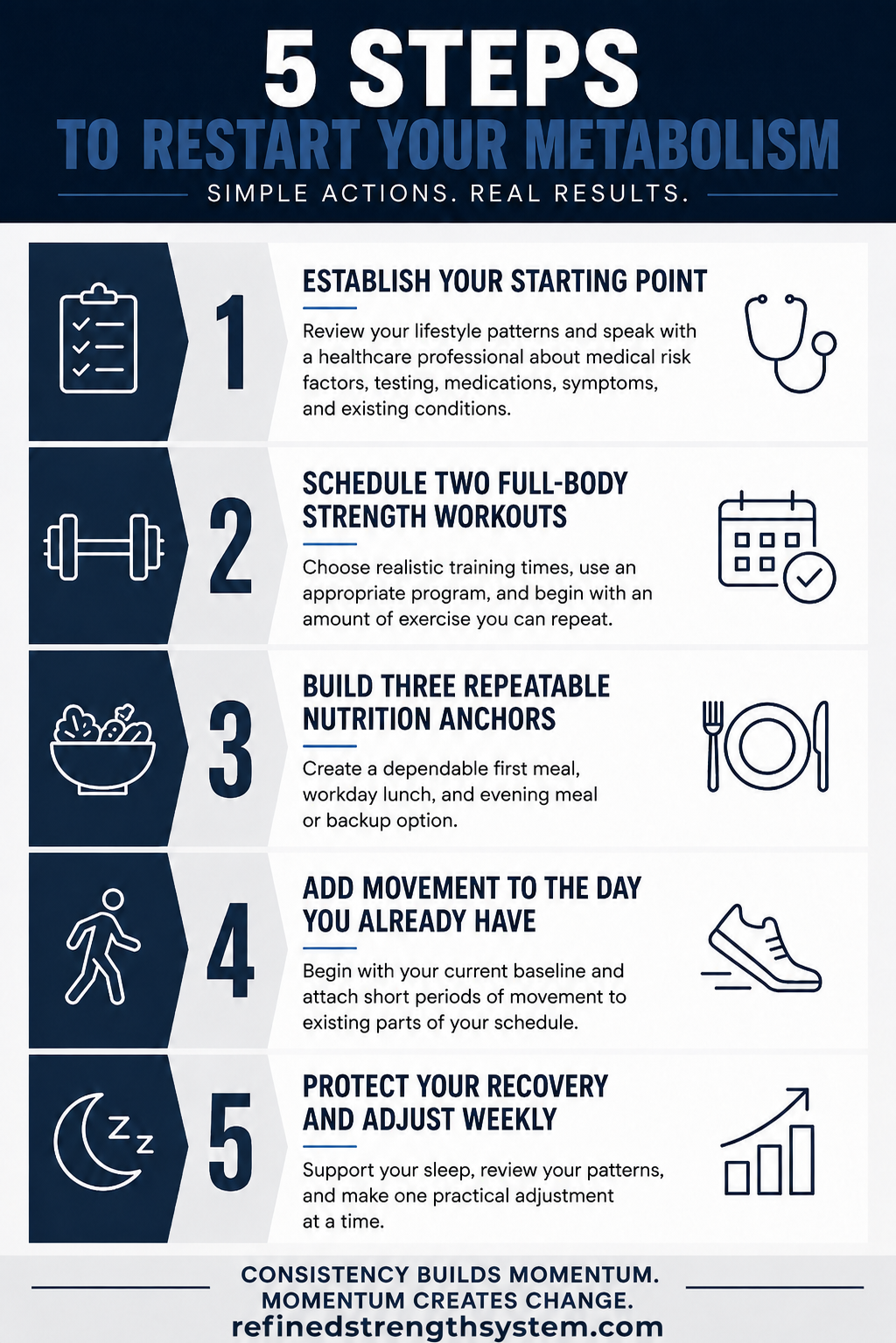
Remember: your goal is not to complete every habit perfectly.
Your goal is to create a structure that works during normal weeks—not only during the easy ones.
I have given you my best tools, strategies, and coaching principles to help you get started. Knowing the steps is helpful, but information alone will not change your routine.
Now it is time to practice.
Ready to Put These Habits Into Practice?
You do not need to rebuild your entire lifestyle this week.
Start by practicing a few important actions, tracking what happens, and learning what fits your schedule.
The free 7-Day Metabolic Test Drive gives you a structured way to begin.
You will receive:
Training and habit tracking
Start and end weigh-ins
Start and end tape measurements
Daily encouragement
Access to a private Facebook group
Support, questions, and accountability
The Test Drive is designed to help you gather personal information, practice consistency, and build momentum.
It does not promise a specific amount of weight loss, guaranteed measurement changes, or the diagnosis, treatment, cure, or reversal of metabolic syndrome.
What it gives you is a place to start.
A Note About Your Health
This article is provided for educational purposes only and is not intended to diagnose, treat, cure, or prevent any medical condition.
If you have metabolic syndrome, diabetes, high blood pressure, cardiovascular disease, take prescription medications, have an existing medical condition, or are concerned about symptoms or laboratory results, speak with your physician or another qualified healthcare professional before making significant changes to your exercise, nutrition, or health routine.
Refined Strength System provides fitness, nutrition, habit, and lifestyle coaching. It does not replace medical care.
Sources & Further Reading
The recommendations in this article are informed by established public-health guidance and current resources from the National Heart, Lung, and Blood Institute, the U.S. Department of Health and Human Services, and the Centers for Disease Control and Prevention.
Metabolic Syndrome
National Heart, Lung, and Blood Institute — Metabolic Syndrome Overview
An overview of metabolic syndrome, associated risk factors, and its relationship to cardiovascular health and diabetes risk.
National Heart, Lung, and Blood Institute — Metabolic Syndrome Diagnosis
Information about how healthcare professionals evaluate metabolic syndrome, including blood pressure, blood glucose, triglycerides, HDL cholesterol, and waist circumference.
National Heart, Lung, and Blood Institute — Causes and Risk Factors
Information about lifestyle, genetics, health conditions, medications, and other factors associated with metabolic syndrome.
Exercise & Daily Movement
U.S. Department of Health and Human Services — Physical Activity Guidelines for Americans
Evidence-based recommendations for aerobic activity, strength training, reducing sedentary time, and gradually increasing physical activity.
Nutrition
Centers for Disease Control and Prevention — Healthy Eating Tips
Practical recommendations for building a balanced eating pattern using nutrient-dense foods.
Centers for Disease Control and Prevention — Healthier Meals and Snacks
Practical guidance for incorporating protein foods, fruits, vegetables, whole grains, and other nutritious foods into everyday meals.
Sleep & Recovery
Centers for Disease Control and Prevention — About Sleep
Guidance on recommended sleep duration and healthy sleep habits for adults.
